
Chemistry can seem like a world of formulas, reactions, and invisible particles, but similes for chemistry can make these ideas easier to understand and more enjoyable to describe. A simile is a comparison that uses words such as “like” or “as” to connect one thing with another in a vivid way. Similes are important in figurative language because they turn difficult, abstract, or technical ideas into images that readers can quickly understand. In chemistry, a well-chosen comparison can make atoms, molecules, reactions, bonds, and energy feel more familiar and memorable. Nature also gives us powerful images for scientific writing, and trees are especially meaningful symbols of strength, growth, resilience, wisdom, and human emotion.
Just as a tree grows from tiny roots into something strong and complex, chemical systems can develop through countless small interactions. These connections between science and nature create useful nature similes, figurative language examples, and comparisons that can make educational and creative writing more engaging. Whether you are writing a poem, science essay, story, lesson, or creative description, the right simile can help chemistry come alive.
What Is a Simile?
A simile is a figure of speech that compares two different things using words such as “like” or “as.” The comparison helps readers understand an idea by connecting it to something familiar.
Example: The chemical reaction spread through the solution like a spark racing through dry grass.
This comparison gives the reader an immediate image of speed and rapid change without describing the reaction in overly technical language.
1. Chemistry Is Like a Living Tree
Meaning: This simile compares chemistry to a living tree because both involve layers of structure, growth, connections, and continuous change.
Usage insight: Use this comparison when discussing how chemistry connects different areas of science or when explaining how simple elements can combine into increasingly complex systems.
Examples:
- Chemistry is like a living tree, with simple elements forming the roots of more complex discoveries.
- The study of chemistry grows like a tree, branching into medicine, biology, engineering, and environmental science.
2. Atoms Are Like Tiny Building Blocks
Meaning: This comparison presents atoms as small units that combine to create larger structures.
Usage insight: It works especially well in educational writing because building blocks are familiar to students and make atomic structure easier to imagine.
Examples:
- Atoms are like tiny building blocks that come together to create countless substances.
- Each atom is like a carefully shaped piece in the enormous structure of matter.
3. Molecules Move Like Dancers in a Crowded Room
Meaning: This simile describes the constant movement and interaction of molecules.
Usage insight: Use it when explaining molecular motion, especially in gases, liquids, or reactions where particles frequently collide.
Examples:
- The molecules moved like dancers in a crowded room as the temperature increased.
- Inside the heated solution, particles shifted like restless dancers searching for space.
4. Chemical Bonds Are Like Invisible Bridges
Meaning: This comparison describes chemical bonds as forces that connect atoms together.
Usage insight: It is useful for explaining bonding to beginners because a bridge provides a clear image of connection between separate points.
Examples:
- Chemical bonds are like invisible bridges connecting atoms within a molecule.
- The invisible bonds held the atoms together like strong bridges spanning a deep valley.
5. A Chemical Reaction Is Like a Domino Effect
Meaning: This simile compares a chemical reaction to one event triggering another in a sequence.
Usage insight: Use it when explaining reaction mechanisms, chain reactions, or processes in which one change leads to another.
Examples:
- The reaction was like a domino effect, with one molecular change triggering the next.
- Once the first bond broke, the process unfolded like a row of dominoes falling in succession.
6. Electrons Move Like Quick Birds
Meaning: This comparison emphasizes the speed and movement associated with electrons.
Usage insight: It can make explanations of electron behavior more vivid, particularly in introductory science writing, while remaining clearly figurative.
Examples:
- Electrons seemed to move like quick birds around the atomic structure.
- The tiny charged particles darted through the material like birds suddenly taking flight.
7. An Acid Is Like a Sharp Tongue
Meaning: This simile uses the idea of sharpness to suggest the reactive or corrosive nature associated with some acids.
Usage insight: It works best in creative science writing, poems, or memorable classroom explanations rather than highly technical descriptions.
Examples:
- The strong acid behaved like a sharp tongue, reacting aggressively with the material.
- The solution was like a sharp voice in the laboratory, demanding attention through its powerful reaction.
8. A Catalyst Is Like a Helpful Guide

Meaning: This simile compares a catalyst to someone who helps a process happen more efficiently without being consumed by the journey.
Usage insight: It is particularly effective for explaining catalysts to students who are encountering the concept for the first time.
Examples:
- A catalyst is like a helpful guide that makes a difficult chemical journey easier.
- The catalyst acted like an experienced guide, allowing the reaction to proceed more efficiently.
9. Heat in a Reaction Is Like a Hidden Fire
Meaning: This comparison presents thermal energy as an unseen force that can drive or accompany chemical change.
Usage insight: Use it when describing energy changes in reactions or when making scientific writing more imaginative.
Examples:
- The heat released by the reaction was like a hidden fire warming the surrounding solution.
- Energy moved through the reaction like an unseen flame beneath the surface.
10. A Chemical Solution Is Like a Blended Orchestra
Meaning: This simile compares different substances or particles in a solution to instruments working together in an orchestra.
Usage insight: It works well when explaining how different components can coexist and interact within a mixture.
Examples:
- The solution was like a blended orchestra, with each substance contributing to the final result.
- Different ions moved through the liquid like musicians following the rhythm of the same composition.
11. The Periodic Table Is Like a Map of Elements
Meaning: This comparison presents the periodic table as a guide that helps scientists understand relationships among elements.
Usage insight: It is useful in educational articles because maps are familiar tools for finding locations and understanding connections.
Examples:
- The periodic table is like a map that guides students through the landscape of the elements.
- Scientists use the periodic table like a detailed map when exploring the properties of matter.
12. Molecular Structure Is Like an Architectural Blueprint
Meaning: This simile compares molecular structure to a blueprint because both show how individual parts are arranged to create a larger structure.
Usage insight: Use it when discussing molecular geometry, chemical structures, or the relationship between arrangement and properties.
Examples:
- A molecular structure is like an architectural blueprint showing how every atom fits into the larger design.
- The formula provided a starting point, while the molecular structure revealed the blueprint of the substance.
13. Chemical Equilibrium Is Like a Balanced Scale
Meaning: This comparison describes equilibrium as a state in which opposing processes remain balanced.
Usage insight: It is especially effective in academic and educational writing when explaining dynamic equilibrium.
Examples:
- Chemical equilibrium is like a balanced scale, with opposing processes maintaining a steady state.
- The reaction reached equilibrium like two carefully balanced sides of a scale.
14. Chemistry Is Like a Puzzle With Moving Pieces
Meaning: This simile emphasizes how chemists combine observations, structures, reactions, and evidence to understand complex problems.
Usage insight: It works well in essays and introductions because it presents chemistry as an active process of discovery rather than a collection of memorized facts.
Examples:
- Chemistry is like a puzzle with moving pieces, where every discovery can change the larger picture.
- Understanding the reaction felt like solving a puzzle whose pieces were constantly rearranging themselves.
15. Chemical Discovery Is Like a Seed Becoming a Tree
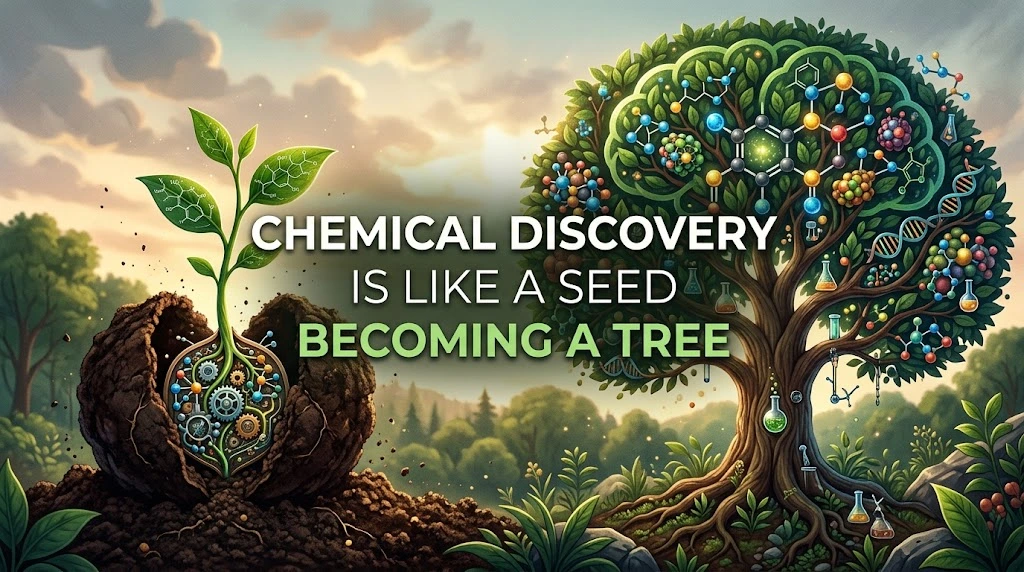
Meaning: This comparison connects scientific discovery with gradual growth from a small beginning into something much larger.
Usage insight: It is ideal for inspirational writing, science essays, and creative descriptions about innovation and progress.
Examples:
- A small chemical discovery can grow like a seed becoming a tree, eventually transforming an entire field.
- The researcher’s early experiment was like a seed that slowly developed into a groundbreaking scientific idea.
How to Use Similes Effectively in Writing
Using similes well is not simply about adding the words “like” or “as” to a sentence. A strong comparison should make an idea clearer, more memorable, or more emotionally meaningful.
1. Use Familiar Images
Choose comparisons that your audience can understand quickly. Building blocks, trees, bridges, maps, puzzles, and dancers are familiar images that can make complicated scientific concepts easier to grasp.
2. Keep Scientific Accuracy in Mind
Similes are figurative, but the underlying science should remain accurate. A comparison should help readers understand a concept rather than create a false scientific impression.
3. Use Similes in Poems
Poetry gives you more freedom to make imaginative comparisons. Chemistry can be compared with stars, rivers, fire, trees, music, or changing seasons to create emotional and visual depth.
4. Add Similes to Stories
In a science-based story, similes can make laboratory scenes, experiments, and discoveries more vivid. Instead of simply saying that a reaction happened quickly, a writer might describe it as moving like a flash of lightning.
5. Strengthen Essays
Academic writing should remain clear and precise, but an occasional carefully chosen simile can make an explanation easier to understand. Use figurative language examples mainly when they clarify an abstract concept.
6. Make Songs More Memorable
Songwriters can use chemistry-related comparisons to explore love, connection, change, attraction, energy, and transformation. Chemical bonds, reactions, and elements can become creative symbols for human experiences.
7. Improve Creative Descriptions
Similes can transform ordinary scientific descriptions into memorable images. Compare a molecule to a structure, a reaction to movement, or energy to an unseen force to give readers a stronger mental picture.
8. Avoid Overusing Comparisons
Too many similes can make writing feel crowded. Select the comparisons that genuinely add meaning, and allow straightforward sentences to carry technical information when precision matters most.
FAQs About Similes for Chemistry
What are some good similes for chemistry?
Good similes for chemistry include “atoms are like building blocks,” “chemical bonds are like invisible bridges,” and “a chemical reaction is like a domino effect.” These comparisons make abstract scientific concepts easier to visualize.
What is the difference between a simile and a metaphor?
A simile directly compares two things using words such as “like” or “as.” A metaphor makes a direct comparison without using those words. For example, “Atoms are like building blocks” is a simile, while “Atoms are building blocks” is a metaphor.
Can similes be used in chemistry essays?
Yes. Similes can make chemistry essays more engaging and easier to understand, particularly when explaining abstract concepts. However, academic writing should prioritize scientific accuracy and use figurative language carefully.
Why are similes useful in creative writing?
Similes add imagery, emotion, and clarity to creative writing. They allow readers to connect unfamiliar ideas with familiar experiences, making descriptions more vivid and memorable.
Can chemistry similes be used in poems and songs?
Absolutely. Chemistry provides many creative themes, including attraction, bonding, reactions, transformation, energy, and connection. These concepts can be turned into expressive comparisons in poems and songs.
Conclusion
Similes for chemistry offer a creative way to connect the precise world of science with familiar images from everyday life and nature. A molecule can move like a dancer, a chemical bond can resemble an invisible bridge, and a reaction can unfold like a domino effect. These comparisons do more than make scientific writing attractive; they help readers build mental pictures of ideas that may otherwise feel abstract or difficult. Nature similes are especially powerful because images such as trees, seeds, rivers, fire, and growth are deeply familiar to people. Like a tree growing from a small seed into something strong and resilient, scientific knowledge can develop through curiosity, observation, experimentation, and discovery. Whether you are writing an academic essay, classroom explanation, poem, song, story, or creative description, thoughtful figurative language can make your message more memorable. The best similes balance imagination with clarity, allowing readers to understand both the comparison and the scientific idea behind it. When used with purpose, these comparisons give chemistry a human voice and add clarity, imagery, and emotional depth to language.