
Courage is one of the strongest qualities a person can have, especially when fear makes the next step difficult. Similes about courage help us describe bravery in a vivid way by comparing it to familiar people, animals, nature, and powerful experiences. A simile is a form of figurative language that usually uses words such as “like” or “as” to create a meaningful comparison. These comparisons make ordinary ideas more memorable because they allow readers to see, feel, and imagine an emotion rather than simply read about it.
Trees are especially powerful symbols of strength, growth, resilience, wisdom, and human emotion because they stand firmly through changing seasons and difficult weather. Like a strong tree bending without breaking in a storm, a courageous person can face hardship while continuing to move forward. Nature similes can therefore make descriptions of bravery feel deeper, more emotional, and easier to understand. Whether you are writing a poem, story, essay, speech, or creative description, the right simile can turn the simple idea of courage into an unforgettable image.
What Is a Simile?
A simile is a figure of speech that compares two different things using words such as “like” or “as.” Writers use similes to make descriptions clearer, more expressive, and more imaginative.
Example:
Her courage was like a lighthouse guiding ships through a violent storm.
This comparison shows that her courage provides direction and hope even when circumstances are frightening or uncertain.
Similes are common in everyday language, poetry, storytelling, speeches, and similes in literature because they help readers connect an abstract feeling with something they can easily picture.
1. Courage Is Like a Tree Rooted Deep in the Earth
Meaning: This simile compares courage to strong roots that hold a tree firmly in the ground. It suggests that true bravery comes from inner strength, confidence, and determination.
Usage insight: Use this comparison when describing someone who remains steady during difficult circumstances. It works particularly well in motivational writing, personal essays, and nature-inspired descriptions.
Examples:
- Her courage was like a tree rooted deep in the earth, steady despite every storm around her.
- Even when doubt surrounded him, his determination remained firmly rooted.
2. Courage Is Like a Flame Burning Through the Darkness
Meaning: This simile presents courage as a small but powerful flame that brings light into frightening or uncertain situations.
Usage insight: It is useful when writing about hope, bravery, overcoming fear, or finding strength during difficult moments.
Examples:
- His courage was like a flame burning through the darkness of uncertainty.
- She carried a quiet bravery that glowed like a candle in a dark room.
3. Courage Is as Strong as an Ancient Oak
Meaning: An ancient oak represents strength, endurance, and stability. Comparing courage to such a tree suggests that bravery can withstand pressure over time.
Usage insight: This is an effective choice for describing lasting courage rather than a sudden act of bravery.
Examples:
- Her courage was as strong as an ancient oak standing through countless winters.
- He faced every challenge with a spirit that seemed stronger than ever.
4. Courage Is Like a Lion Facing the Storm
Meaning: This comparison connects courage with the lion, an animal often associated with strength, confidence, and fearlessness.
Usage insight: Use this simile when describing bold action or someone who refuses to retreat when confronted by danger.
Examples:
- The young leader stood like a lion facing the storm.
- She entered the difficult conversation with the confidence of a lion protecting its pride.
5. Courage Is Like a Mountain That Will Not Move
Meaning: Mountains symbolize permanence and stability. This simile suggests that courage remains firm even when challenges attempt to shake it.
Usage insight: It works especially well when describing emotional resilience, determination, or someone who refuses to give up.
Examples:
- His courage was like a mountain that would not move beneath the pressure.
- She remained calm and steady while everyone else began to panic.
6. Courage Is as Bright as Sunrise After a Long Night

Meaning: This simile compares courage with sunrise, suggesting that bravery can bring hope after fear, sadness, or uncertainty.
Usage insight: Use it when you want your writing to have an uplifting and hopeful emotional tone.
Examples:
- Her courage was as bright as sunrise after a long and difficult night.
- His decision to begin again felt like the first light of morning.
7. Courage Is Like a River Cutting Through Stone
Meaning: A river may seem gentle, but over time it can shape even hard stone. This comparison shows that courage does not always need to be loud or aggressive to be powerful.
Usage insight: This is one of the most useful nature similes for describing quiet persistence and long-term determination.
Examples:
- Her courage was like a river cutting patiently through stone.
- He changed his life through steady effort rather than dramatic gestures.
8. Courage Is Like a Shield Against the Wind
Meaning: A shield protects someone from danger, while wind can represent pressure, criticism, or adversity. The simile suggests that courage provides emotional protection.
Usage insight: Use this comparison when describing someone who stands firm despite opposition or criticism.
Examples:
- His courage was like a shield against the harsh winds of doubt.
- Her confidence protected her from the criticism surrounding her decision.
9. Courage Is as Steady as a Lighthouse in a Storm
Meaning: A lighthouse remains in place while waves crash around it. This simile presents courage as a dependable source of guidance during chaos.
Usage insight: It works beautifully in speeches, inspirational writing, and stories about leadership or difficult choices.
Examples:
- Her courage was as steady as a lighthouse in a storm.
- When everyone felt lost, his calm determination gave them direction.
10. Courage Is Like a Seed Breaking Through Hard Soil
Meaning: A tiny seed pushing through hard soil represents determination, growth, and the strength to overcome obstacles.
Usage insight: This is an excellent comparison for personal growth, recovery, new beginnings, and overcoming fear.
Examples:
- His courage was like a seed breaking through hard soil to find the sunlight.
- She discovered an unexpected strength while rebuilding her life.
11. Courage Is Like a Bird Flying Into the Unknown
Meaning: A bird leaving the safety of its familiar surroundings represents the bravery required to face uncertainty.
Usage insight: Use this simile when writing about taking risks, starting over, traveling toward a new goal, or entering an unfamiliar situation.
Examples:
- Her courage was like a bird flying freely into an unknown sky.
- He accepted the opportunity with the nervous excitement of someone beginning a new journey.
12. Courage Is as Fierce as Fire in Winter
Meaning: Fire provides warmth and energy in a cold environment. This simile presents courage as a fierce inner force that helps someone survive hardship.
Usage insight: It is particularly effective when describing someone who maintains determination during emotionally or physically difficult circumstances.
Examples:
- Her courage was as fierce as fire burning through the coldest winter.
- His determination kept the team moving when exhaustion began to take over.
13. Courage Is Like a Bridge Over a Deep Chasm
Meaning: A bridge allows people to cross a dangerous or difficult gap. This simile suggests that courage helps people move from fear toward possibility.
Usage insight: Use it when describing difficult decisions, major transitions, or the first step toward a challenging goal.
Examples:
- Courage was like a bridge carrying her safely across the chasm of fear.
- Taking that first step became a pathway toward a completely different future.
14. Courage Is Like a Wolf Walking Alone Through Snow
Meaning: This image suggests independence, endurance, and the ability to continue even without support from others.
Usage insight: It works well for characters who must make difficult choices independently or remain strong when they feel isolated.
Examples:
- His courage was like a lone wolf moving through deep snow without turning back.
- She continued toward her goal even when no one else understood her decision.
15. Courage Is Like a Star Refusing to Fade
Meaning: A star shining in the night can symbolize hope, persistence, and inner strength. The comparison suggests that courage continues even when everything around a person feels dark.
Usage insight: This simile is ideal for emotional writing, poetry, inspirational messages, and stories about resilience.
Examples:
- Her courage was like a star refusing to fade beneath the darkness.
- Even after disappointment, his hope continued to shine.
More Similes About Courage for Creative Writing
The following comparisons can give writers additional ways to describe bravery without repeating the same imagery:
- Courage is like a compass pointing toward hope.
- Courage is as firm as a cliff above the sea.
- Courage is like thunder awakening a silent sky.
- Courage is as patient as a river shaping a canyon.
- Courage is like a kite rising against the wind.
- Courage is as powerful as waves striking the shore.
- Courage is like a torch carried through a dark forest.
- Courage is as calm as a mountain beneath falling snow.
- Courage is like a sail catching a difficult wind.
- Courage is as enduring as a desert surviving the heat.
- Courage is like a phoenix rising from ashes.
- Courage is as fearless as an eagle above the clouds.
- Courage is like a sturdy branch refusing to snap.
- Courage is as warm as sunlight after a freezing night.
- Courage is like a path appearing through a dense forest.
- Courage is as deep as roots hidden beneath the soil.
- Courage is like a wave returning to the shore again and again.
- Courage is as bold as lightning across a midnight sky.
- Courage is like a seed carrying a forest inside it.
- Courage is as persistent as rain wearing down stone.
These figurative language examples can help students, poets, authors, and speakers describe courage in ways that feel visual and emotionally meaningful.
Why Nature Similes Work So Well for Courage
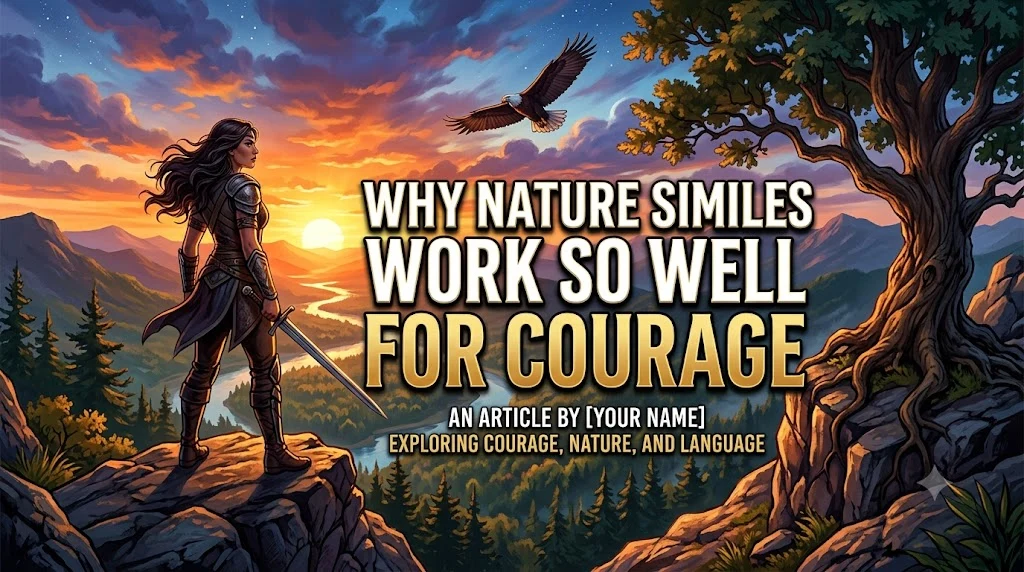
Nature provides some of the strongest imagery for describing bravery. A mountain can represent stability, a tree can represent resilience, a river can represent persistence, and a sunrise can represent hope.
Trees are especially valuable symbols because they grow slowly but become strong over time. Their roots hold them in place, their branches reach toward the sky, and their trunks endure changing seasons. For this reason, trees can represent courage that develops through experience rather than appearing instantly.
Nature similes also make abstract emotions easier to visualize. Instead of simply saying that someone is “very brave,” a writer can say:
Her courage stood like an oak against the storm.
The reader immediately receives a stronger mental image. This is one reason nature similes are frequently useful in poetry, creative writing, speeches, and inspirational content.
Similes About Courage in Literature
Writers have long used comparisons involving nature, animals, weather, light, and journeys to communicate bravery. In similes in literature, courage is rarely presented only as an abstract quality. Instead, it can be connected to storms, mountains, fire, oceans, birds, trees, stars, and other powerful images.
This approach helps readers understand emotional experiences through familiar physical scenes.
For example, comparing courage to a mountain emphasizes stability. . Comparing it to a river emphasizes persistence. Comparing it to a bird emphasizes freedom and the willingness to enter the unknown.
When studying literary examples, pay attention to three things:
- The object of comparison: What represents courage?
- The shared quality: What does the object and courage have in common?
- The emotional effect: What does the comparison make the reader feel?
Understanding these elements makes it easier to create original similes rather than copying familiar expressions.
How to Use Similes Effectively in Writing
Using similes effectively is not simply about adding the words “like” or “as.” A strong comparison should add meaning, imagery, or emotion to your writing.
1. Choose a Clear Connection
Make sure readers can understand why the two things are being compared. If you compare courage to a mountain, the shared qualities might be strength, stability, and endurance.
2. Avoid Overused Comparisons
Common expressions can sometimes feel predictable. Try creating fresh comparisons based on specific images, experiences, or elements of nature.
Instead of:
He was as brave as a lion.
You could write:
His courage was like a tree holding firm against a winter storm.
The second version creates a more specific picture.
3. Use Similes in Poems
Poetry depends heavily on imagery and emotional language. A carefully selected simile can turn an abstract feeling into a memorable picture.
For example:
Her courage rose like dawn over a sleeping valley.
4. Use Similes in Stories
In fiction, similes can reveal character traits without directly explaining them. Instead of saying that a character is courageous, show how their behavior resembles something strong or enduring.
5. Use Similes in Essays
Academic and explanatory writing should remain clear, so use comparisons carefully. A simple simile can help explain an abstract concept, especially in personal essays, reflective writing, and educational pieces.
6. Use Similes in Speeches
A powerful comparison can make a speech easier to remember. If you are discussing leadership or overcoming adversity, a simile involving a lighthouse, mountain, or storm can reinforce your message.
7. Use Similes in Songs
Songs often depend on emotional imagery. Comparisons involving fire, rain, stars, oceans, and roads can make lyrics more vivid and expressive.
8. Match the Simile to the Mood
Not every courage simile needs to sound heroic. Sometimes courage is quiet, patient, or uncertain.
For example:
Her bravery was like a small seed pushing through frozen ground.
This suggests courage that is delicate but persistent.
9. Do Not Overload Your Writing
One strong comparison is usually more effective than several unrelated ones. Choose the image that best supports your message.
10. Make Your Comparison Emotionally Relevant
The best similes do more than describe appearance. They communicate feelings and ideas. A good comparison should help readers understand what courage feels like from the inside.
Similes vs. Metaphors: What Is the Difference?
Both similes and metaphors make comparisons, but they do so differently.
A simile directly compares two things using words such as “like” or “as.”
Her courage was like a mountain.
A metaphor makes a direct comparison without using “like” or “as.”
Her courage was a mountain.
Both sentences communicate strength, but the simile signals the comparison more directly.
In simple terms:
- Simile: Courage is like a mountain.
- Metaphor: Courage is a mountain.
- Simile: He fought like a lion.
- Metaphor: He was a lion in the face of danger.
Both forms are valuable comparisons, and skilled writers can use them together to create variety and emotional depth.
FAQs About Similes About Courage
What are some good similes about courage?
Some strong examples include “Courage is like a mountain that will not move,” “Courage is like a flame burning through the darkness,” and “Courage is like a river cutting through stone.” Each comparison emphasizes a different quality, such as strength, hope, or persistence.
What is a simile for being courageous?
A useful simile for being courageous is: “She stood like a lighthouse in a storm.” It suggests that the person remains calm, steady, and dependable despite difficult circumstances.
What is the difference between a simile and a metaphor?
A simile uses words such as “like” or “as” to make a comparison, while a metaphor makes a direct comparison. For example, “His courage was like a mountain” is a simile, while “His courage was a mountain” is a metaphor.
Can similes be used in academic writing?
Yes. Similes can be useful in essays, reflective assignments, explanations, and other forms of academic writing when they clarify an abstract concept. However, they should be relevant and used sparingly so the writing remains precise.
Why are similes useful in creative writing?
Similes make abstract ideas such as courage, fear, love, sadness, and hope easier to visualize. They add imagery and emotional depth while helping readers connect an unfamiliar idea with something familiar.
Conclusion: Let Courage Become a Picture
Similes about courage give writers a powerful way to transform bravery from an abstract idea into something readers can see and feel. A courageous person can be compared to a mountain that refuses to move, a tree that survives the storm, a river that reshapes stone, or a star that continues shining through darkness. These comparisons add clarity, imagery, and emotional depth to language while making descriptions more memorable. The strongest similes do not merely say that someone is brave; they show what that bravery looks like, feels like, and means. Nature is especially rich with inspiration because trees, mountains, rivers, oceans, fire, birds, and stars all carry qualities that naturally connect with human resilience. Whether you are creating a poem, writing a story, preparing a speech, completing an essay, or developing a creative description, a thoughtful comparison can make your words much more powerful. The next time you need to describe courage, look beyond the simple word “brave” and search for an image that captures its true spirit. Like a tree standing through every season, strong language can remain rooted, grow with meaning, and leave a lasting impression on every reader.