
Beauty can be difficult to describe because ordinary words often cannot capture what we truly see or feel. Similes for beautiful make descriptions more vivid by comparing beauty to familiar people, places, objects, colors, and moments in nature. A simile is a form of figurative language that uses words such as “like” or “as” to create a clear and memorable comparison. These comparisons help readers imagine beauty instead of simply being told that something is beautiful.
Nature offers some of the strongest images for describing beauty because flowers, sunsets, rivers, stars, and trees carry deep emotional meaning. Trees, in particular, are powerful symbols of strength, growth, resilience, wisdom, and human emotion, making them inspiring sources for nature similes. In literature, writers use comparisons like these to give characters, landscapes, and emotions greater depth and personality. Whether you are writing a poem, story, essay, song, or creative description, the right simile can make your language more expressive and unforgettable.
What Is a Simile?
A simile is a figure of speech that directly compares two different things using words such as “like” or “as.” Similes help readers create mental pictures and understand qualities such as beauty, kindness, strength, sadness, or joy more clearly.
Example: Her smile was like sunlight breaking through the clouds.
This comparison does more than say that her smile was beautiful; it suggests that it was warm, bright, comforting, and uplifting.
1. As Beautiful as a Garden in Full Bloom
Meaning: This simile describes beauty that is rich, colorful, fresh, and full of life. A garden filled with blooming flowers creates an image of natural beauty and abundance.
Usage insight: Use this comparison when describing a person, place, celebration, or scene that feels vibrant and visually pleasing.
Examples:
- The courtyard was as beautiful as a garden in full bloom after the spring rain.
- Her personality was as beautiful as a garden in full bloom, welcoming everyone with warmth.
2. Beautiful Like Moonlight on Still Water
Meaning: This comparison suggests a quiet, graceful, and peaceful kind of beauty. Moonlight reflected on calm water creates a soft and almost magical image.
Usage insight: It works especially well for romantic writing, poetry, nighttime descriptions, and peaceful scenes.
Examples:
- The lake looked beautiful like moonlight on still water beneath the cloudless sky.
- Her voice was beautiful like moonlight on still water, gentle enough to calm the room.
3. As Beautiful as a Rose at Dawn
Meaning: This simile connects beauty with freshness, elegance, delicacy, and new beginnings.
Usage insight: Use it when describing someone or something whose beauty feels youthful, graceful, or newly discovered.
Examples:
- She looked as beautiful as a rose at dawn in the soft morning light.
- The young garden was as beautiful as a rose at dawn, fresh with color and promise.
4. Beautiful Like a Star in a Midnight Sky
Meaning: This comparison describes beauty that stands out against darkness and immediately attracts attention.
Usage insight: It is useful for describing a person who catches everyone’s eye or an object that becomes the focus of a dark or quiet setting.
Examples:
- Her silver dress was beautiful like a star in a midnight sky.
- His kindness was beautiful like a star in a midnight sky, especially during difficult times.
5. As Beautiful as a Mountain at Sunrise
Meaning: This simile represents majestic, powerful, and breathtaking beauty. A mountain illuminated by sunrise can appear both peaceful and magnificent.
Usage insight: It works well for landscapes, architecture, people with a commanding presence, and moments that inspire awe.
Examples:
- The valley was as beautiful as a mountain at sunrise, glowing beneath the golden light.
- Her confidence was as beautiful as a mountain at sunrise, calm yet impossible to ignore.
6. Beautiful Like a Butterfly in Spring
Meaning: This comparison suggests delicate, colorful, lively, and graceful beauty.
Usage insight: Use it for descriptions involving transformation, youth, freedom, or someone whose presence brings color and energy.
Examples:
- She moved across the garden, beautiful like a butterfly in spring.
- The new artwork was beautiful like a butterfly in spring, filled with delicate colors.
7. As Beautiful as a Sunset Over the Sea

Meaning: This simile expresses dramatic, peaceful, and unforgettable beauty. A sunset over the ocean combines color, light, distance, and calmness.
Usage insight: It is ideal for romantic scenes, travel writing, poetry, and descriptions of memorable moments.
Examples:
- The wedding ceremony was as beautiful as a sunset over the sea.
- Her final performance was as beautiful as a sunset over the sea, leaving everyone silent for a moment.
8. Beautiful Like a Crystal-Clear Stream
Meaning: This comparison connects beauty with purity, freshness, clarity, and natural simplicity.
Usage insight: Use it when describing something that feels clean, peaceful, transparent, or refreshingly natural.
Examples:
- Her laughter was beautiful like a crystal-clear stream flowing through the forest.
- The village was beautiful like a crystal-clear stream, simple and untouched by noise.
9. As Beautiful as a Snow-Covered Forest
Meaning: This simile suggests quiet, elegant, pristine, and almost magical beauty.
Usage insight: It works particularly well for winter scenes, peaceful landscapes, and descriptions where beauty comes from stillness.
Examples:
- The countryside was as beautiful as a snow-covered forest beneath the pale morning sky.
- Her white gown looked as beautiful as a snow-covered forest in winter.
10. Beautiful Like a Painting by the Sea
Meaning: This comparison presents beauty as artistic, carefully composed, colorful, and visually captivating.
Usage insight: It is effective when describing scenery, architecture, clothing, or a carefully arranged setting.
Examples:
- The little coastal town was beautiful like a painting by the sea.
- The room looked beautiful like a painting by the sea, with soft colors and open windows.
11. As Beautiful as a Sunlit Meadow
Meaning: This simile suggests warmth, freshness, happiness, and natural charm.
Usage insight: Use it when the beauty you are describing feels cheerful, welcoming, and full of positive energy.
Examples:
- Her smile was as beautiful as a sunlit meadow after a long winter.
- The park was as beautiful as a sunlit meadow filled with wildflowers.
12. Beautiful Like a Feather Floating on the Breeze
Meaning: This comparison suggests delicate, effortless, graceful, and gentle beauty.
Usage insight: It is especially useful for describing movement, gestures, voices, clothing, or people with a soft presence.
Examples:
- Her dance was beautiful like a feather floating on the breeze.
- The white curtains moved beautifully like feathers floating on the breeze.
13. As Beautiful as an Ancient Tree
Meaning: This simile combines beauty with wisdom, strength, history, and resilience. An ancient tree can be beautiful because of everything it has survived.
Usage insight: Use this comparison when describing mature beauty, inner strength, wisdom, or a person whose character has grown through experience.
Examples:
- Her spirit was as beautiful as an ancient tree, shaped by years of experience.
- The old garden was as beautiful as an ancient tree, carrying memories in every branch.
14. Beautiful Like a Pearl Beneath the Waves
Meaning: This simile describes rare, subtle, precious, and naturally elegant beauty.
Usage insight: It works well when beauty is understated or discovered gradually rather than immediately noticed.
Examples:
- Her quiet confidence was beautiful like a pearl beneath the waves.
- The hidden beach was beautiful like a pearl beneath the waves, waiting for travelers to discover it.
15. As Beautiful as a Rainbow After Rain
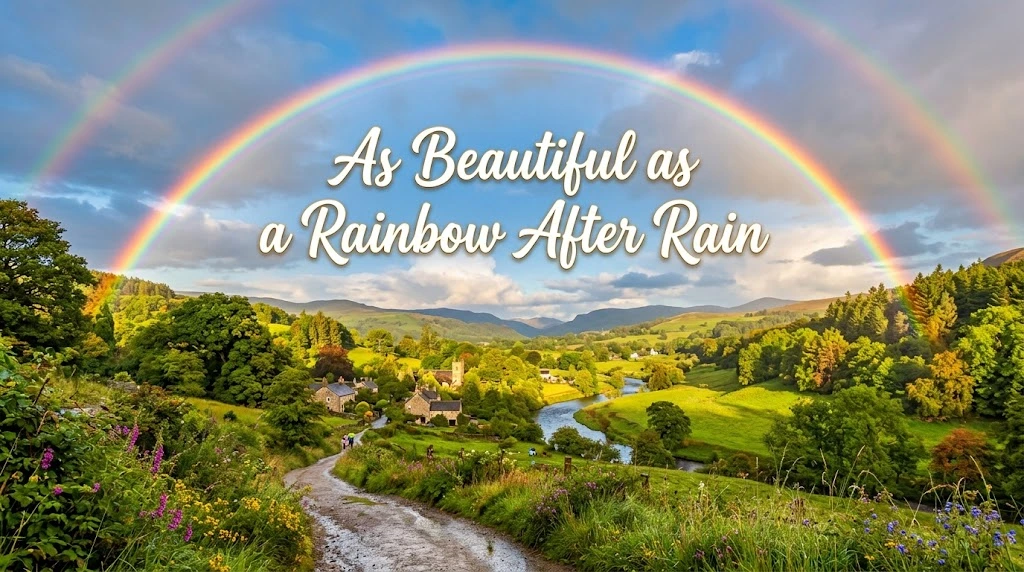
Meaning: This comparison represents colorful, hopeful, joyful, and uplifting beauty that appears after difficulty.
Usage insight: It is especially powerful when describing emotional healing, new beginnings, hope, or happiness after a challenging period.
Examples:
- Her renewed smile was as beautiful as a rainbow after rain.
- The friendship they rebuilt was as beautiful as a rainbow after rain, stronger because of what they had endured.
How to Use Similes Effectively in Writing
Using similes for beautiful effectively is about choosing a comparison that adds meaning rather than simply adding decorative words. A strong simile should help readers see, feel, or understand the subject in a fresh way.
1. Use Nature Similes for Vivid Descriptions
Nature provides endless sources of beautiful comparisons. Flowers, trees, oceans, stars, mountains, sunsets, rivers, and butterflies can make descriptions more visual and emotional.
Instead of writing:
The garden was beautiful.
Try:
The garden was as beautiful as a sunlit meadow.
The second sentence gives readers a specific picture.
2. Match the Simile to the Type of Beauty
Not every beautiful thing has the same quality. A person may be graceful, peaceful, radiant, mysterious, elegant, or powerful.
For example:
- Graceful beauty: like a feather floating on the breeze
- Majestic beauty: like a mountain at sunrise
- Peaceful beauty: like moonlight on still water
- Colorful beauty: like a rainbow after rain
- Timeless beauty: like an ancient tree
Choosing the right comparison makes your writing more precise.
3. Use Similes in Poems
Poetry depends heavily on imagery and emotional language. A well-chosen simile can turn a simple feeling into a memorable image.
For example:
Her hope rose like the morning sun.
This creates a stronger emotional picture than simply saying:
She became hopeful.
4. Add Similes to Stories
In fiction, similes can strengthen character descriptions and settings. Instead of repeatedly using words such as beautiful, pretty, or lovely, compare the subject to something readers already recognize.
This keeps descriptions fresh while revealing the writer’s perspective.
5. Use Comparisons Carefully in Essays
Academic writing usually requires clarity and evidence, but similes can still appear in introductions, reflective essays, personal narratives, and descriptive assignments. Keep them relevant and avoid using too many figurative expressions in formal analytical writing.
6. Make Song Lyrics More Emotional
Songs often rely on comparisons because listeners can understand an image quickly. A line such as “Your love shines like morning light” communicates warmth and hope in a compact form.
7. Avoid Overused Comparisons
Common phrases can be useful, but original comparisons are often more memorable. Instead of relying only on familiar expressions, experiment with nature, weather, architecture, music, and everyday experiences.
8. Keep the Comparison Natural
A simile should make sense immediately. If the connection between the two things is too complicated, readers may focus on understanding the comparison rather than enjoying the description.
FAQs About Similes for Beautiful
1. What are some good similes for beautiful?
Some effective examples include “as beautiful as a garden in full bloom,” “beautiful like moonlight on still water,” and “as beautiful as a sunset over the sea.” The best choice depends on the type of beauty you want to communicate.
2. What is the difference between a simile and a metaphor?
A simile makes a comparison using words such as like or as. For example, “Her smile was like sunshine.” A metaphor makes a direct comparison without those words: “Her smile was sunshine.”
3. Can similes be used in academic writing?
Yes, but they should be used thoughtfully. Similes are most appropriate in descriptive, reflective, literary, and creative academic writing. In highly technical or analytical sections, direct and precise language is usually preferable.
4. Why are similes useful in creative writing?
Similes create imagery and help readers experience a description more vividly. Instead of simply telling readers that something is beautiful, a comparison can show what kind of beauty it has.
5. How can I create my own similes for beautiful?
Think about the specific quality of beauty you want to express, then connect it with something that shares that quality. For example, if the beauty is peaceful, you might compare it to moonlight on still water; if it is powerful, you might compare it to a mountain at sunrise.
Conclusion
Similes for beautiful give writers a powerful way to transform simple descriptions into vivid and meaningful images. Instead of repeatedly saying that something is beautiful, comparisons allow you to show whether its beauty is peaceful like moonlight, colorful like a rainbow, graceful like a feather, or majestic like a mountain at sunrise. These figurative language examples make writing more memorable because they connect unfamiliar or abstract ideas with images readers already understand. Nature similes are especially effective because the natural world offers endless examples of color, strength, growth, elegance, and resilience. Trees remind us that beauty can exist alongside strength and experience, while flowers, stars, rivers, and sunsets reveal other forms of wonder. Whether you are writing poetry, fiction, songs, essays, or personal descriptions, a thoughtful comparison can add clarity, imagery, and emotional depth to your words. Choose your comparisons carefully, keep them natural, and let your language paint a picture that readers can see and feel. With the right simile, even the simplest description of beauty can become unforgettable.