
Imagine meeting someone whose ideas seem to move faster than everyone else’s, whose questions reveal a deep understanding, and whose solutions appear almost effortless. Finding the right words to describe that kind of intelligence can be difficult, especially when ordinary adjectives such as “smart” or “clever” feel too simple. This is where similes to describe intelligence can make language more vivid, memorable, and expressive. A simile compares one thing with another using words such as “like” or “as,” helping readers picture an abstract quality through something familiar.
In figurative language, similes are valuable because they transform ideas and emotions into clear images that readers can easily understand. Nature also gives writers powerful symbols, and trees often represent strength, growth, resilience, wisdom, and human emotion through their deep roots and steady branches. Just as a tree grows quietly while becoming stronger over time, a truly intelligent person can develop knowledge, insight, and wisdom through experience. Whether you are writing a poem, story, essay, speech, or character description, the right comparison can make intelligence feel vivid rather than merely stated.
What Is a Simile?
A simile is a figure of speech that compares two different things using words such as “like” or “as.” Similes help writers explain an idea by connecting it to something familiar, creating a stronger mental picture for the reader.
Example: Her mind was like a finely tuned compass, always pointing toward the right solution.
This comparison does more than say that she is intelligent. It suggests that her thinking is accurate, focused, and dependable.
1. His Mind Was Like a Lightning Storm
Meaning: This simile describes someone whose thoughts are extremely fast, energetic, and powerful. Their mind may produce ideas almost as quickly as lightning flashes across the sky.
Usage Insight: Use this comparison when describing quick thinkers, creative problem-solvers, or people who rapidly connect different ideas. It works particularly well in stories and character descriptions.
Examples:
- His mind was like a lightning storm, striking upon solutions before anyone else had finished thinking.
- During the debate, Maya’s ideas flashed through the room like lightning from a restless sky.
2. She Was as Sharp as a Needle
Meaning: Being “as sharp as a needle” suggests exceptional mental sharpness, quick understanding, and an ability to notice small details.
Usage Insight: This is useful when describing analytical intelligence. It works especially well for students, detectives, researchers, and characters who quickly recognize important information.
Examples:
- She was as sharp as a needle and noticed the contradiction hidden in the report.
- His sharp reasoning made him as precise in conversation as a needle is on a compass.
3. His Brain Was Like a Well-Stocked Library
Meaning: This simile presents a person as knowledgeable, informed, and capable of drawing upon a large collection of facts and ideas.
Usage Insight: Use it when intelligence is connected with learning, memory, education, or broad knowledge rather than quick thinking alone.
Examples:
- His brain was like a well-stocked library, filled with fascinating facts about history and science.
- Whenever the class had a difficult question, Priya’s well-stocked mind seemed to have an answer ready.
4. She Was as Wise as an Ancient Oak
Meaning: This comparison connects intelligence with wisdom, patience, maturity, and experience. The ancient oak symbolizes knowledge that has developed gradually over many years.
Usage Insight: This is one of the strongest nature similes for describing thoughtful intelligence. Use it for older characters, mentors, teachers, or anyone whose wisdom comes from experience.
Examples:
- She was as wise as an ancient oak, offering calm advice whenever others felt lost.
- His decisions carried the quiet confidence of someone as wise as an ancient oak.
5. His Thoughts Moved Like a River Finding the Sea
Meaning: This simile describes intelligence that is fluid, persistent, and naturally capable of finding a solution. Like a river, the mind may move around obstacles without losing its direction.
Usage Insight: Use this comparison when you want intelligence to feel calm and adaptable rather than aggressive or overwhelmingly fast.
Examples:
- His thoughts moved like a river finding the sea, flowing around every obstacle in the problem.
- Even when the plan failed, her reasoning continued like a river searching for open ground.
6. She Was as Clever as a Fox in a Hidden Forest
Meaning: The fox traditionally represents cleverness, awareness, and strategic thinking. This simile suggests someone who can understand situations quickly and act intelligently.
Usage Insight: It works especially well for fictional characters, storytelling, adventure writing, and descriptions of strategic intelligence.
Examples:
- She was as clever as a fox in a hidden forest, always noticing what others overlooked.
- The young strategist was as clever as a fox, quietly preparing for every possible outcome.
7. His Mind Was Like a Telescope Among Blurred Windows
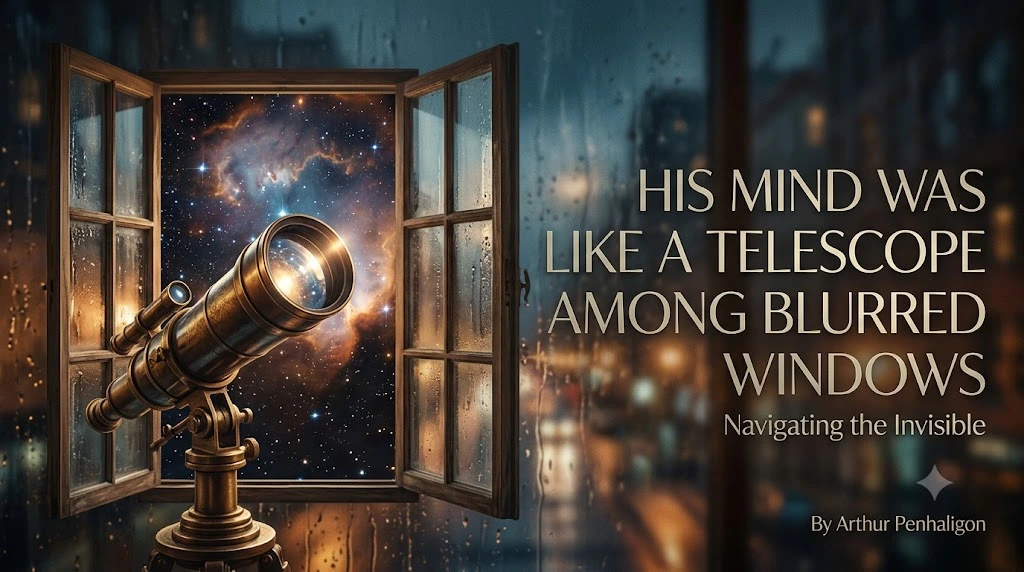
Meaning: This original comparison describes someone who can see beyond confusion and recognize details that others cannot.
Usage Insight: Use it when describing analytical or visionary intelligence. It is particularly effective when a person understands a complicated situation more clearly than everyone around them.
Examples:
- His mind was like a telescope among blurred windows, bringing distant possibilities into focus.
- While everyone else saw confusion, Elena’s thinking worked like a telescope and revealed the larger pattern.
8. She Was as Quick-Witted as a Sparrow Dodging the Wind
Meaning: This simile emphasizes mental speed, flexibility, and the ability to react intelligently to unexpected situations.
Usage Insight: It is ideal for describing someone who thinks quickly during conversations, debates, competitions, or difficult moments.
Examples:
- She was as quick-witted as a sparrow dodging the wind, answering every question with ease.
- His humor was as quick as a sparrow changing direction in the wind.
9. His Knowledge Was Like Deep Ocean Water
Meaning: This simile suggests that a person’s knowledge is broad, profound, and difficult to measure. It emphasizes depth rather than speed.
Usage Insight: Use this comparison when describing scholars, experts, researchers, teachers, or people with extensive knowledge of a subject.
Examples:
- His knowledge of ancient civilizations was like deep ocean water, extending far beyond what most people could see.
- Beneath her quiet personality was a depth of understanding like deep ocean water.
10. Her Reasoning Was as Clear as a Mountain Spring
Meaning: A mountain spring is often associated with purity and clarity. This comparison describes thinking that is logical, understandable, and free from unnecessary confusion.
Usage Insight: This is especially useful for essays, academic writing, speeches, and professional descriptions where intelligence is shown through clear reasoning.
Examples:
- Her reasoning was as clear as a mountain spring, making the complicated theory easy to understand.
- The professor explained the difficult concept with thoughts as clear as water from a mountain spring.
11. His Ideas Were Like Seeds That Grew Into Forests
Meaning: This simile describes creative intelligence and the ability to turn small ideas into large, meaningful possibilities.
Usage Insight: It works beautifully when describing inventors, writers, entrepreneurs, students, and creative thinkers whose ideas develop over time.
Examples:
- His ideas were like seeds that grew into forests, beginning as simple thoughts and becoming ambitious projects.
- One question from the student became an idea that grew like a seed into an entire research project.
12. She Was as Observant as an Owl at Midnight
Meaning: Owls are commonly associated with alertness, observation, and wisdom. This simile describes someone who notices details even when other people fail to see them.
Usage Insight: Use it for characters who possess perceptive intelligence, especially detectives, investigators, readers, or careful observers.
Examples:
- She was as observant as an owl at midnight, noticing the tiny clue everyone else ignored.
- As observant as an owl, Daniel could detect changes in people’s expressions almost instantly.
13. His Memory Was Like a Camera With Perfect Focus
Meaning: This simile highlights exceptional memory and the ability to remember information with remarkable accuracy.
Usage Insight: It is useful when describing academic ability, strong recall, or someone who remembers conversations, details, dates, and experiences with unusual precision.
Examples:
- His memory was like a camera with perfect focus; he could recall every detail of the experiment.
- She remembered names and dates as clearly as a camera captures a perfectly focused image.
14. Her Intelligence Was Like a Lantern in a Dark Forest
Meaning: This comparison presents intelligence as a source of guidance and understanding. Like a lantern, knowledge can illuminate uncertainty and help people find their way.
Usage Insight: Use this simile when intelligence helps solve problems, guide others, or bring clarity during difficult circumstances.
Examples:
- Her intelligence was like a lantern in a dark forest, helping the entire team find a way forward.
- His thoughtful explanation became a lantern in the confusion, showing everyone what to do next.
15. His Mind Was as Flexible as a Willow in the Wind

Meaning: This simile describes adaptable intelligence. Rather than being rigid, an intelligent person can reconsider ideas, accept new evidence, and adjust to changing circumstances.
Usage Insight: This is especially effective when describing emotional intelligence, open-mindedness, creativity, or practical problem-solving.
Examples:
- His mind was as flexible as a willow in the wind, adapting easily when new evidence appeared.
- She remained calm and open-minded, with reasoning as flexible as a willow bending in a summer breeze.
Why Similes Are Powerful for Describing Intelligence
Intelligence is an abstract quality. You cannot physically see someone’s intelligence in the same way you can see their clothing, height, or facial expression. Because of this, simply writing “he was intelligent” often gives readers very little to imagine.
A strong simile changes that.
For example:
Simple: He was intelligent.
With a simile: His mind was like a lightning storm, producing ideas faster than anyone could follow.
The second sentence creates movement, energy, and imagery. The reader can almost visualize the person’s thoughts.
This is one reason figurative language examples are so useful in creative writing. They allow writers to turn abstract qualities such as intelligence, courage, kindness, fear, and wisdom into concrete images.
Similes in Literature and Creative Writing
Similes in literature have long been used to make characters, emotions, settings, and ideas more memorable. Writers often compare a person’s qualities to animals, landscapes, weather, objects, or natural phenomena.
When a wise character is compared to an ancient oak, the image suggests experience, stability, and resilience.
These comparisons also make writing more emotionally engaging.
Instead of telling readers what a character is like, a writer can show the quality through an image. That approach is particularly valuable in novels, poetry, personal essays, speeches, and character descriptions.
Nature Similes for Intelligence
Nature provides some of the richest material for describing intelligence. Trees, rivers, mountains, oceans, birds, and stars all carry symbolic meanings that readers recognize intuitively.
For example:
- An ancient oak can represent wisdom and experience.
- A mountain spring can represent clarity and pure reasoning.
- A river can represent adaptable and continuous thought.
- An owl can represent observation and wisdom.
- A willow can represent flexibility and open-mindedness.
- A forest can represent complex knowledge and interconnected ideas.
- A lantern in the wilderness can represent intelligence that provides guidance.
These nature similes are especially effective because they connect human intelligence to familiar images from the natural world.
How to Use Similes Effectively in Writing
Knowing several similes is useful, but knowing when and how to use them is even more important. A strong comparison should support your meaning rather than distract from it.
1. Use Similes in Poems
Poetry depends heavily on imagery, emotion, rhythm, and association. A carefully chosen simile can help readers feel an abstract idea.
Instead of writing:
Her wisdom was extraordinary.
You might write:
Her wisdom stood like an ancient oak, rooted deeply in experience.
The image gives the poem greater emotional and visual depth.
2. Use Similes in Stories
Similes are excellent tools for character development. Rather than repeatedly telling readers that a character is intelligent, show their intelligence through comparisons.
For example:
His mind was like a map covered with roads no one else could see.
This tells readers that the character thinks deeply and recognizes possibilities that others miss.
3. Use Similes in Essays
Academic writing generally requires clarity and precision, so figurative language should be used carefully. A simple, controlled comparison can sometimes make a complex idea easier to understand.
For example:
Critical thinking can function like a filter, separating reliable evidence from unsupported claims.
The comparison clarifies the concept without making the writing overly decorative.
4. Use Similes in Songs
Songs often rely on emotional imagery. A simile can make intelligence feel personal, romantic, inspiring, or mysterious.
For instance:
Your mind shines like a star above a silent sea.
The comparison creates an emotional picture while keeping the language memorable.
5. Use Similes in Creative Descriptions
Creative descriptions benefit from comparisons that engage the senses. Think about what the intelligence looks, sounds, or feels like.
Instead of:
He was very intelligent.
Try:
His thoughts moved like a river, always finding a path around the obstacles.
This creates a stronger impression of the character.
6. Choose Comparisons That Match the Type of Intelligence
Not all intelligence is the same. Consider the quality you want to emphasize.
- Quick thinking: lightning, a sparrow, a flash of light
- Wisdom: ancient trees, mountains, old books
- Knowledge: libraries, oceans, vast forests
- Clarity: springs, clear skies, polished glass
- Creativity: seeds, stars, fireworks
- Observation: owls, telescopes, watchtowers
- Adaptability: rivers, willows, wind
- Problem-solving: maps, compasses, lanterns
Choosing the right image makes the simile more precise.
7. Avoid Overusing Similes
A paragraph filled with comparisons can become difficult to read. Strong writing often depends on balance.
Choose one excellent simile rather than several ordinary ones. The goal is not to decorate every sentence but to make important ideas more vivid.
8. Keep the Comparison Natural
A simile should make sense immediately. If readers have to spend too much time figuring out the connection, the comparison may weaken your message.
Ask yourself:
Does this image clearly communicate the quality I want to describe?
If the answer is yes, the simile is likely to work.
Similes vs. Metaphors: What Is the Difference?
Similes and metaphors are both forms of figurative language, but they make comparisons differently.
A simile directly signals the comparison using words such as “like” or “as.”
Simile: Her mind was like a bright lantern in the darkness.
A metaphor makes a more direct comparison without using “like” or “as.”
Metaphor: Her mind was a bright lantern in the darkness.
Both examples communicate intelligence as a source of clarity, but the simile openly tells the reader that one thing is being compared with another.
FAQs About Similes to Describe Intelligence
What are good similes to describe intelligence?
Some effective similes include “as wise as an ancient oak,” “as clear as a mountain spring,” “as sharp as a needle,” and “his mind was like a well-stocked library.” The best choice depends on whether you want to emphasize wisdom, clarity, sharpness, knowledge, creativity, or quick thinking.
What is a simile for a very intelligent person?
A strong example is: “Her mind was like a lightning storm, producing brilliant ideas in rapid flashes.” This suggests that the person is extremely quick-thinking, energetic, and creative.
What is the difference between a simile and a metaphor?
A simile uses comparison words such as “like” or “as,” while a metaphor makes a direct comparison. For example, “His mind is like a library” is a simile, while “His mind is a library” is a metaphor.
Can similes be used in academic writing?
Yes, but they should be used selectively. In academic writing, a clear comparison can help explain a difficult idea, but excessive figurative language may reduce precision. Simple, purposeful similes are generally more effective than decorative ones.
Why are similes useful in creative writing?
Similes make abstract qualities easier to visualize. Instead of simply telling readers that someone is intelligent, a writer can compare their mind to a library, river, telescope, or lantern, giving readers a clearer and more memorable image.
Conclusion: Let Your Similes Make Intelligence Visible
The best similes to describe intelligence do more than replace the word “smart.” They reveal how intelligence behaves, feels, and influences the world around it. A brilliant mind can flash like lightning, flow like a river, shine like a lantern, or hold knowledge as deep as an ocean. These comparisons give readers something concrete to imagine while adding clarity, imagery, personality, and emotional depth to language. Nature similes are especially powerful because trees, rivers, mountains, birds, and forests already carry rich symbolic meanings that connect naturally with human qualities. Whether you are describing a thoughtful character, writing a poem, creating an essay, composing a song, or developing a story, the right simile can turn an ordinary sentence into something memorable. The key is to choose comparisons that genuinely match the kind of intelligence you want to express. When used thoughtfully, similes become more than decorative phrases—they become bridges between an abstract idea and a vivid human experience. So the next time “intelligent” feels too ordinary, reach for a stronger image and let your language show readers exactly what brilliance looks like.