
A great speech can inform people, but a memorable speech can make people feel something deeply. Similes help speakers create that emotional connection by comparing one idea with another using words such as “like” or “as.” These simple comparisons make difficult ideas easier to understand and give ordinary words a stronger visual and emotional effect. In speeches, figurative language can turn an abstract message into an image that listeners can quickly imagine and remember.
Nature similes are especially powerful because people naturally understand images of trees, rivers, mountains, storms, sunlight, and flowers. Trees, for example, are powerful symbols of strength, growth, resilience, wisdom, and human emotion because they remain rooted while continuing to reach toward the sky. Just as a tree grows through changing seasons, people and communities can develop through challenges, failures, and victories. By using meaningful similes for speeches, speakers can make their ideas clearer, more expressive, persuasive, and memorable.
What Is a Simile?
A simile is a figure of speech that compares two different things using words such as “like” or “as.” The comparison helps the audience understand an idea by connecting it to something familiar, vivid, or emotionally meaningful.
Example:
“Hope is like a candle shining through the darkness.”
This simile does more than say that hope is helpful. It creates a mental picture of a small light overcoming darkness, making the idea more emotional and memorable.
In speeches, similes can strengthen arguments, introduce important themes, inspire audiences, and make complex thoughts easier to understand.
1. Courage Is Like a Lighthouse in a Storm
Meaning: This simile compares courage to a lighthouse that continues shining even when powerful waves and darkness surround it. It represents strength, guidance, and determination during difficult moments.
Usage Insight: Use this comparison in motivational, leadership, graduation, or inspirational speeches when discussing courage during uncertainty.
Examples:
- “Courage is like a lighthouse in a storm, guiding us when the path ahead seems impossible to see.”
- “When challenges surround us, our courage can shine like a lighthouse against the darkest night.”
2. Hope Is Like a Seed Beneath the Soil
Meaning: This comparison shows that hope may not always be visible, but it can quietly grow until it becomes something powerful.
Usage Insight: This simile works particularly well in speeches about recovery, perseverance, social change, personal growth, or difficult times.
Examples:
- “Hope is like a seed beneath the soil, growing quietly even when we cannot see the progress.”
- “Every small act of kindness plants hope like a seed waiting for the right season to bloom.”
3. Knowledge Is Like a Key That Opens Doors
Meaning: Knowledge is compared to a key because learning gives people access to new opportunities, ideas, and possibilities.
Usage Insight: This is useful for educational speeches, school presentations, graduation addresses, and discussions about personal development.
Examples:
- “Knowledge is like a key that opens doors we once believed were permanently closed.”
- “Every lesson we learn gives us another key to unlock the possibilities ahead.”
4. A Strong Community Is Like a Forest
Meaning: A forest contains many trees that support an entire ecosystem, making it a strong image for unity, cooperation, and community.
Usage Insight: Use this simile when speaking about teamwork, family, society, friendship, or collective responsibility.
Examples:
- “A strong community is like a forest, where every individual contributes to the strength of the whole.”
- “We become stronger when we stand together like trees in a thriving forest.”
5. Determination Is Like a River Cutting Through Stone
Meaning: A river does not need to destroy a rock instantly; it gradually shapes it through continuous movement. The simile represents patience and persistence.
Usage Insight: This comparison is excellent for motivational speeches about achieving goals despite obstacles.
Examples:
- “Determination is like a river cutting through stone; steady effort can overcome even the hardest obstacles.”
- “We do not need to win every battle today because persistence can shape our future like water shapes stone.”
6. A Dream Is Like a Star on a Dark Night
Meaning: This simile presents a dream as something bright and hopeful that gives people direction when life feels uncertain.
Usage Insight: It fits naturally into graduation speeches, inspirational talks, career speeches, and presentations about ambition.
Examples:
- “A dream is like a star on a dark night, giving us something bright to follow.”
- “Even when the road becomes uncertain, our dreams can shine like distant stars.”
7. Wisdom Is Like an Old Tree
Meaning: An old tree represents experience, patience, stability, and deep roots. Comparing wisdom to such a tree suggests that true understanding develops over time.
Usage Insight: This is especially effective when discussing age, experience, leadership, history, or lessons learned from life.
Examples:
- “Wisdom is like an old tree, strengthened by years of storms and seasons.”
- “The lessons of experience stand like deep roots beneath the decisions we make today.”
8. Unity Is Like Threads Woven Into a Strong Rope

Meaning: A single thread may be fragile, but many threads woven together create strength. The comparison shows the power of cooperation.
Usage Insight: Use it in speeches about teamwork, equality, social responsibility, leadership, or national unity.
Examples:
- “Unity is like threads woven into a strong rope; together, we can carry burdens that none of us could carry alone.”
- “Our differences do not have to divide us when our shared purpose binds us like strong threads.”
9. Leadership Is Like a Compass in Unfamiliar Territory
Meaning: A compass helps people find direction, just as good leadership helps a group move toward a meaningful goal.
Usage Insight: This simile is well suited to business presentations, leadership speeches, student elections, and professional talks.
Examples:
- “Leadership is like a compass in unfamiliar territory, helping people move forward with confidence.”
- “A true leader provides direction like a compass without forcing others to walk the journey alone.”
10. Failure Is Like a Rough Stone That Shapes a Sculpture
Meaning: Failure may feel unpleasant, but it can help develop character, knowledge, and skill just as rough stone can be shaped into something beautiful.
Usage Insight: This is a strong choice for speeches about resilience, entrepreneurship, achievement, education, and personal growth.
Examples:
- “Failure is like a rough stone that shapes a sculpture, revealing strength we did not know we possessed.”
- “Every mistake can become part of the process that shapes us like stone beneath a sculptor’s hands.”
11. Kindness Is Like Sunshine After Rain
Meaning: Sunshine after rain represents warmth, relief, hope, and renewed happiness. Kindness can have the same effect on someone’s life.
Usage Insight: Use this gentle nature simile in speeches about compassion, friendship, community service, or helping others.
Examples:
- “Kindness is like sunshine after rain, bringing warmth to people who have been facing difficult days.”
- “A simple act of compassion can brighten someone’s life like sunlight breaking through the clouds.”
12. Time Is Like Sand Slipping Through Our Fingers
Meaning: This comparison emphasizes how quickly time passes and how difficult it is to hold on to moments once they are gone.
Usage Insight: This simile works especially well in reflective speeches about life, priorities, opportunities, and making meaningful choices.
Examples:
- “Time is like sand slipping through our fingers, reminding us that every moment deserves attention.”
- “Opportunities can disappear like grains of sand before we realize how valuable they were.”
13. Change Is Like the Wind Through the Trees
Meaning: Wind moves through trees and changes their surroundings without remaining in one place. This creates an image of change as something natural, powerful, and unavoidable.
Usage Insight: Use this comparison when discussing personal transformation, technological progress, social change, or new beginnings.
Examples:
- “Change is like the wind through the trees; we may not see it, but we can feel its effects everywhere.”
- “Instead of fearing change, we can learn to move with it like branches responding to the wind.”
14. Words Are Like Seeds Planted in the Mind
Meaning: Words can remain in people’s thoughts and grow into ideas, beliefs, emotions, or actions, just as seeds develop over time.
Usage Insight: This is particularly powerful in speeches because it reminds the speaker that every statement can influence the audience long after the speech ends.
Examples:
- “Our words are like seeds planted in the mind, and we should choose carefully what we want them to grow.”
- “A thoughtful sentence can take root like a seed and inspire someone years after the speech is over.”
15. Perseverance Is Like a Mountain Trail
Meaning: A mountain trail may be steep, winding, and difficult, but every step takes a traveler closer to the summit. The simile represents persistence through hardship.
Usage Insight: This comparison is ideal for motivational speeches about goals, education, leadership, success, and overcoming adversity.
Examples:
- “Perseverance is like a mountain trail, demanding patience but rewarding every determined step.”
- “Success may require a difficult climb, but each challenge moves us higher like another step toward the summit.”
Why Similes Make Speeches More Powerful
Speeches are heard rather than simply read, so speakers need language that listeners can understand quickly. A well-chosen simile creates an image in the audience’s mind without requiring a long explanation.
For example, saying “We must remain strong during difficult times” communicates an idea clearly. However, saying “We must stand like trees against the storm” creates a stronger visual image.
Similes can help speeches:
- Make abstract ideas easier to understand.
- Create vivid mental pictures.
- Strengthen emotional connections.
- Make important points easier to remember.
- Add rhythm and variety to spoken language.
- Make persuasive arguments more engaging.
- Connect complicated ideas with familiar experiences.
- Give a speech a more memorable and creative voice.
This is why similes appear so often in speeches, poetry, storytelling, literature, and other forms of expressive communication.
Similes in Literature and Speeches
Similes in literature have long helped writers communicate emotions, descriptions, and ideas in memorable ways. Authors use comparisons to make characters more vivid, settings more atmospheric, and emotions more understandable.
Speakers can use the same technique.
A writer might use a comparison to describe a character’s fear, while a speaker can use one to describe a community’s uncertainty. A novelist might compare hope to light, while a motivational speaker might use the same general image to explain how hope can guide people through hardship.
The key is choosing comparisons that support the message instead of simply adding decorative language.
Nature Similes for Inspirational Speeches
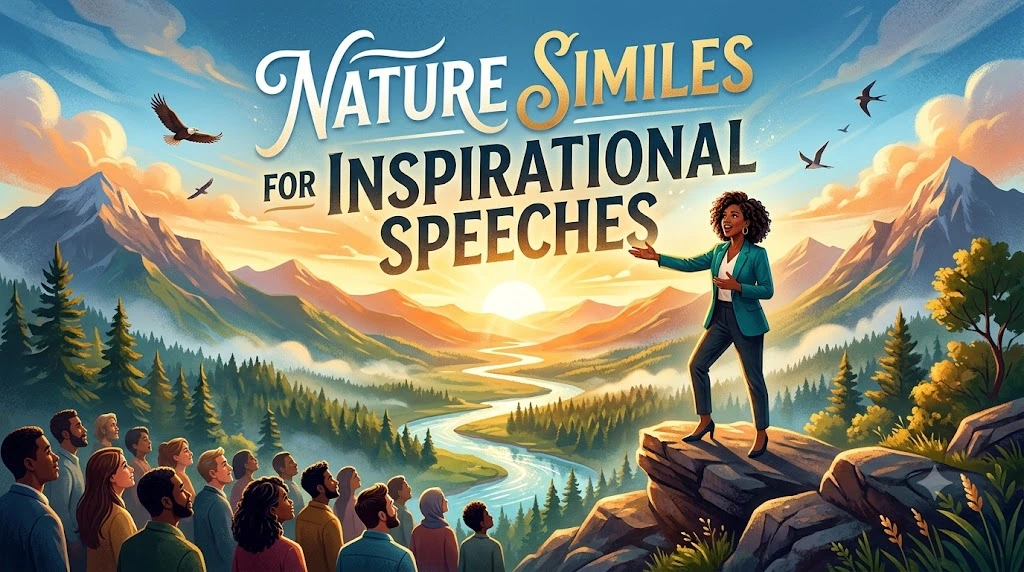
Nature provides some of the most effective imagery for public speaking because natural objects are familiar to almost everyone. Trees can represent strength and growth, mountains can symbolize challenges, rivers can represent persistence, and sunlight can suggest hope.
Some useful nature-based comparisons include:
- Strength is like a mountain standing against the wind.
- Hope is like sunlight breaking through clouds.
- Growth is like a tree reaching toward the sky.
- Resilience is like grass rising after heavy rain.
- Peace is like a still lake at sunrise.
- Progress is like a river moving steadily toward the sea.
- Courage is like a flame protected from the wind.
These nature similes can make speeches feel more universal because they connect human experiences with images people already understand.
Figurative Language Examples for Powerful Speeches
Similes are only one form of figurative language. Speakers can combine them with other techniques to make their communication more engaging.
Simile
Uses “like” or “as” to make a comparison.
Example: “Her determination was like a mountain.”
Metaphor
Makes a direct comparison without using “like” or “as.”
Example: “Her determination was a mountain.”
Personification
Gives human qualities to something nonhuman.
Example: “Hope knocked quietly at the door of his heart.”
Hyperbole
Uses deliberate exaggeration for emphasis.
Example: “We have waited a thousand years for this moment.”
Using these forms carefully can create stronger figurative language examples and give speeches greater variety.
How to Use Similes Effectively in Writing
Whether you are writing a speech, poem, story, essay, song, or creative description, a simile should serve a purpose. Here are practical ways to use comparisons effectively.
1. Choose a Familiar Image
Your audience should understand the comparison quickly. Common images such as trees, rivers, stars, roads, fire, light, and mountains can communicate ideas effectively.
2. Match the Simile to Your Message
Do not choose a comparison simply because it sounds beautiful. If you are discussing resilience, an image of a tree surviving a storm may work better than an unrelated comparison.
3. Keep Spoken Similes Clear
In speeches, listeners cannot reread a sentence. Avoid overly complicated comparisons that require too much explanation.
4. Use Emotional Imagery Carefully
A strong simile can make an audience feel hope, courage, sadness, excitement, or determination. Choose imagery that supports the emotional purpose of your speech.
5. Avoid Too Many Comparisons
Using a simile in every sentence can weaken its impact. A few well-placed comparisons are often more effective than a long series of unrelated ones.
6. Use Similes to Explain Abstract Ideas
Ideas such as freedom, justice, leadership, courage, hope, and success can sometimes feel difficult to visualize. A carefully chosen comparison gives these concepts a concrete image.
7. Make the Comparison Natural
The best similes feel effortless. Avoid forcing two unrelated ideas together simply to sound creative.
8. Read the Speech Aloud
Because speeches are designed to be heard, read your similes aloud. If a comparison sounds awkward, overly long, or difficult to understand, simplify it.
9. Give Your Best Simile Space
A powerful comparison deserves attention. Place an important simile before a key message, after an important point, or near the conclusion so the audience has time to absorb it.
10. Connect the Image Back to Your Message
After using a strong comparison, explain why it matters when necessary. This allows the audience to understand not only the image but also the larger idea behind it.
FAQs About Similes for Speeches
What are good similes for speeches?
Good similes for speeches compare important ideas with familiar and powerful images. Examples include “Hope is like a candle in the darkness,” “Courage is like a lighthouse in a storm,” and “Determination is like a river cutting through stone.”
What is the difference between a simile and a metaphor?
A simile makes a comparison using words such as “like” or “as.” A metaphor makes a direct comparison without those words. For example, “Her voice was like music” is a simile, while “Her voice was music” is a metaphor.
Can similes be used in academic writing?
Yes, but they should be used selectively. In academic writing, similes can help explain complicated concepts or make an argument easier to understand, but formal assignments generally benefit from precise and evidence-based language rather than excessive figurative language.
Why are similes useful in creative writing?
Similes make descriptions more vivid and help readers visualize emotions, characters, places, and experiences. They can add imagery and emotional depth to poems, stories, essays, songs, and other creative writing.
How do similes improve a speech?
Similes can make a speech easier to understand, more emotional, and more memorable. A strong comparison transforms an abstract message into a concrete mental image that listeners can quickly recognize and remember.
Conclusion
The right words can change the way an audience sees an idea, and similes for speeches are one of the simplest ways to create that change. A powerful comparison can turn courage into a lighthouse, determination into a river, hope into a seed, and unity into a strong rope. These images make language easier to understand while giving important messages greater emotional depth. Nature similes are particularly effective because trees, mountains, rivers, stars, sunlight, and storms provide familiar images that naturally connect with human experiences. When used thoughtfully, similes can strengthen speeches, creative writing, poems, essays, stories, and presentations without making the language feel complicated. The best comparisons are clear, relevant, memorable, and closely connected to the speaker’s central message. So, when you want your next speech to do more than deliver information, choose words that allow your audience to see, feel, and remember your message. A carefully crafted simile may be only one sentence, but it can leave an image in the mind long after the final words have been spoken.